

Legacy of Valor and Resilience: The Story of the Bellore Arasula Parari Family.
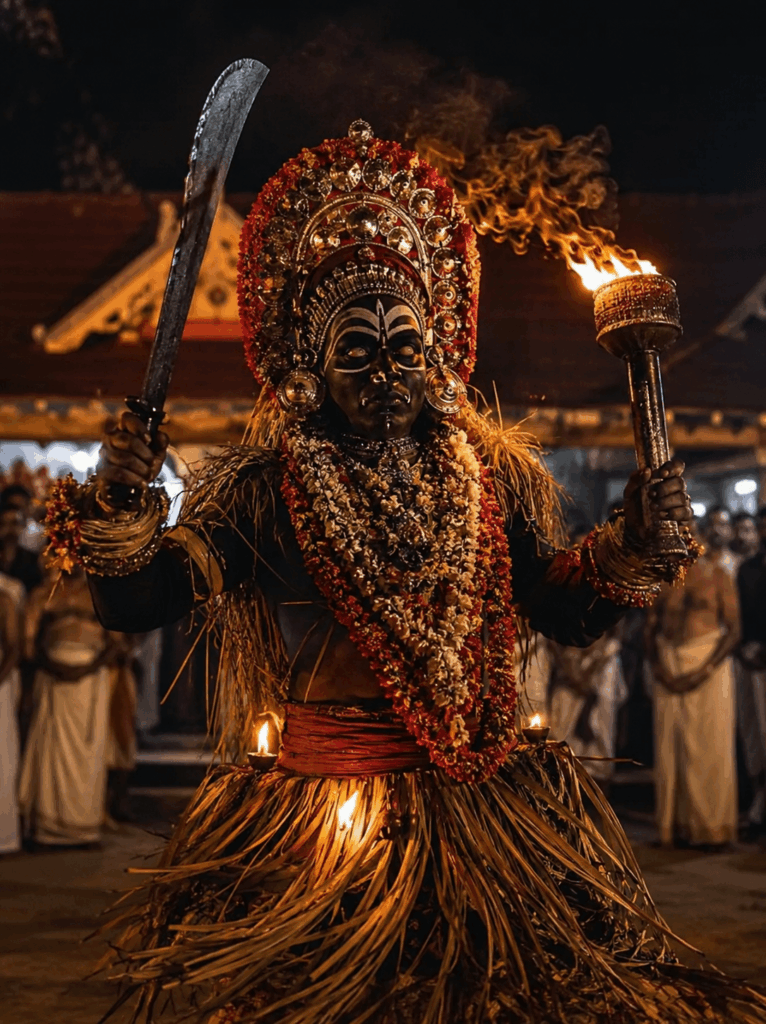
In the cultural and spiritual landscape of Tulunadu, Daivas are not distant or abstract deities. They are guardians who remain intimately connected to the land, the people, and the lineage they protect. Through the sacred tradition of Bhoota Kola, these Daivas are not merely worshipped but experienced…. speaking ,guiding and intervening in the lives of those who seek them. Unlike temple-based worship that often places the divine at a distance, Daiva worship is immediate and relational. It is built on trust, memory, and continuity. These spirits are believed to have once walked the earth,as protectors, warriors, or beings deeply tied to justice and sacrifice. For many families of the region, especially Bunt families, Daivas are not just spiritual figures but are a part of the family identity. They define belonging, preserve moral order, and offer
protection across generations. Their presence is invoked in times of uncertainty, celebration, conflict, and transition, making them inseparable from both the spiritual and social fabric of life.
Daivas of this family are understood as a sacred blend of those who belong to the land and those who journeyed with our forefathers, along with those who were brought into our fold through shared lives and labor. Maadlaya and Kodmantaya are of the land,deeply rooted in the very soil our family has lived upon. Their presence is ancient, and inseparable from the geography and spirit of the place. Doomavati Banta, Moola Maisandaya, Sathyadevathe, Kallurti (Kaluti), and Panjuruli are believed to have come with our forefathers, journeying alongside them, choosing to remain as protectors of the lineage wherever it took root. Chamundi and Guliga are said to have been brought by those who worked alongside our family,reminding us that protection, faith, and devotion are not limited by hierarchy, but grow through shared lives and mutual trust. Together, these Daivas form not just a spiritual system, but a living heritage, that reflects movement, belonging, protection, and continuity.
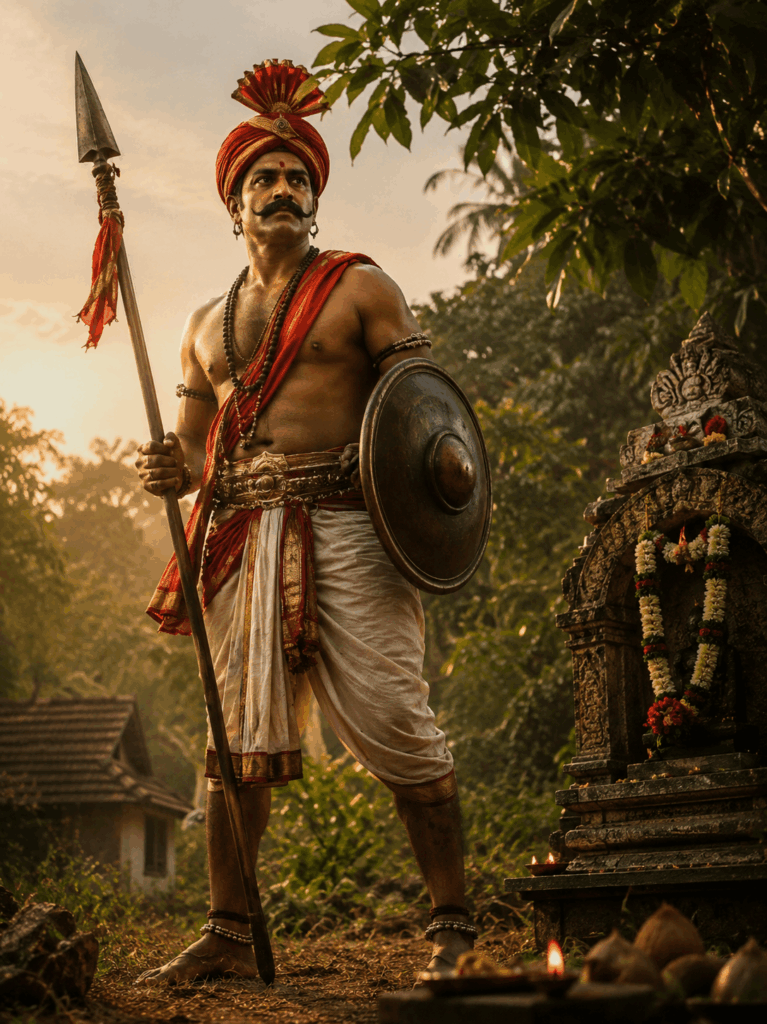
Maadlaya is often depicted as a noble warrior-protector. In the ancient agrarian hierarchy of
Tulunadu, he was the spirit who oversaw the “Beete” (The Ritual Hunt). He wasn’t just a hunter
of animals, but a hunter of injustice. Legend says he was a local hero who sacrificed his life to
protect the boundaries of his village from invaders. Upon his death, he didn’t leave the land; he
became its “Sthala” (Stationed) guardian.
Today,he is the “Landlord” of Bellore Arasula Parari. He ensures that the literal ground you walk
on is sanctified and that our family’s property remains secure from encroachment or legal
disputes.
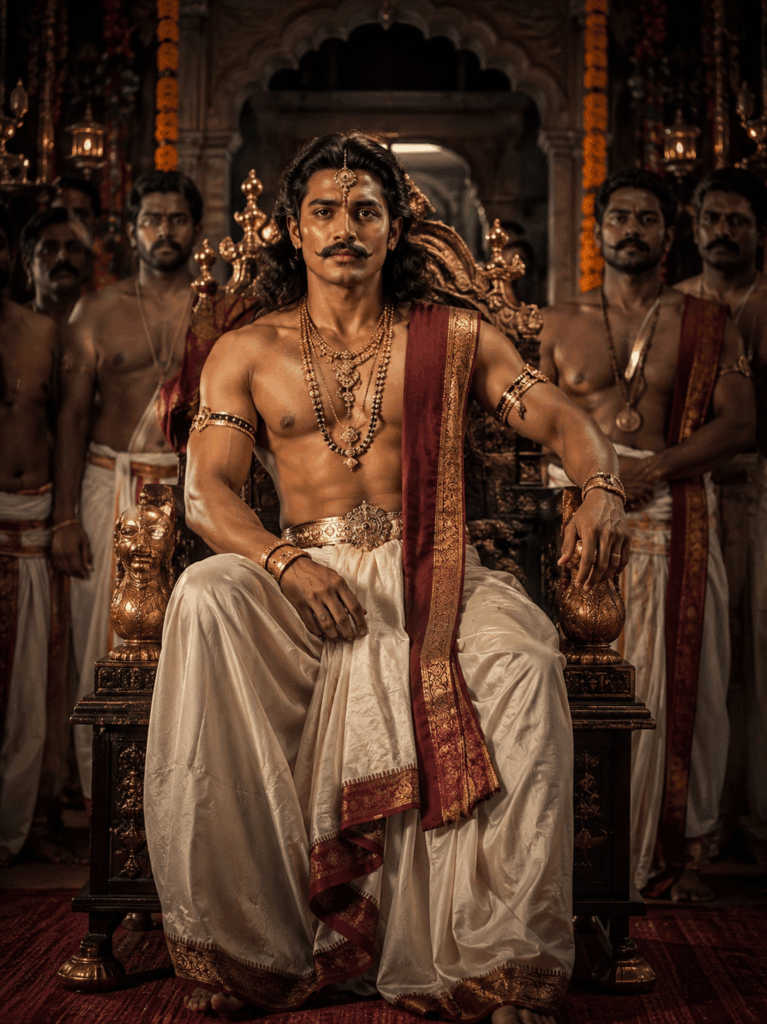
Kodmantaya was a royal prince of the Kuntala dynasty. He was known for his extreme good
looks and martial skill. However later, his journey was marked by a quest for a “place of rest”
(Sana). He travelled across the Netravati river, performing miracles and settling dispues
between warring Bunt landlords. He eventually chose to settle in the households of those who
showed him true devotion and offered him a “Peeta” (throne).
As a royal spirit, he brings prestige and dignity to this family. He acts as a mediator, ensuring
that the family’s internal relationships remain harmonious
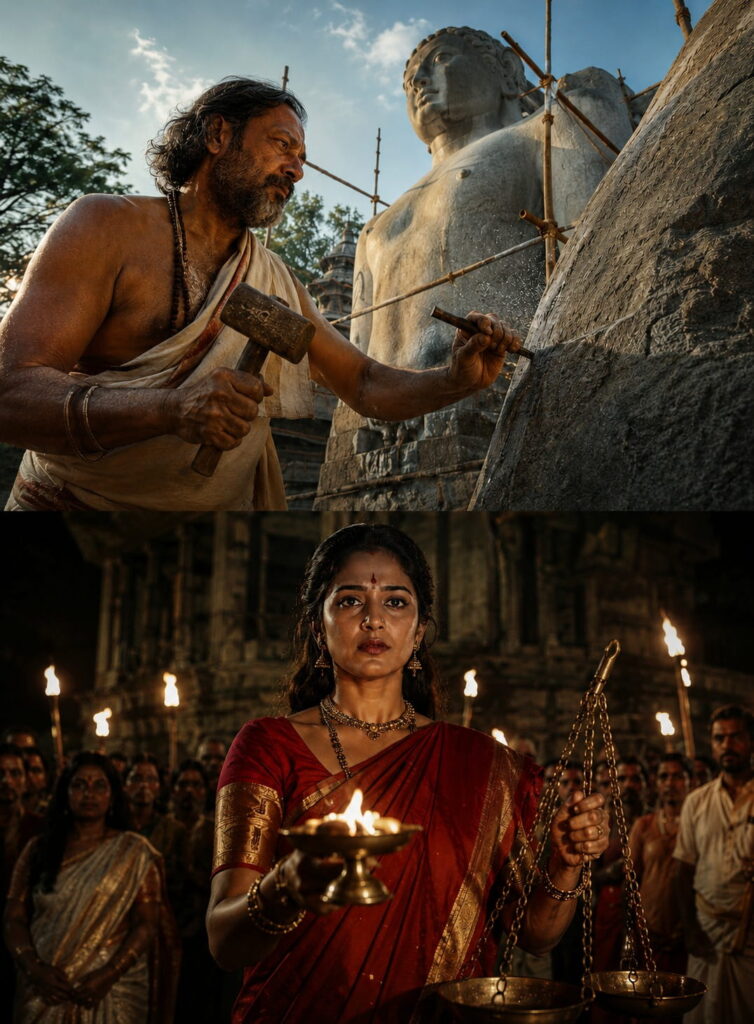
This is one of the most famous stories in Tulunadu. Kalkuda was a legendary sculptor who
carved the Gommateshwara statue at Karkala. To prevent him from creating anything more
beautiful, King Bhairarasa of Karkala ordered his right hand and left leg to be cut off. His sister,
Kallurti, went searching for him. Seeing his state, her grief turned into a terrifying divine rage.
The siblings took their own lives and became spirits, destroying the King’s palace and
demanding justice.
Kallurti is the Redresser of Wrongs. If the family is ever treated unfairly or cheated, she is the
one who “demands back” what was lost. She is the fierce protector of the family’s honor.
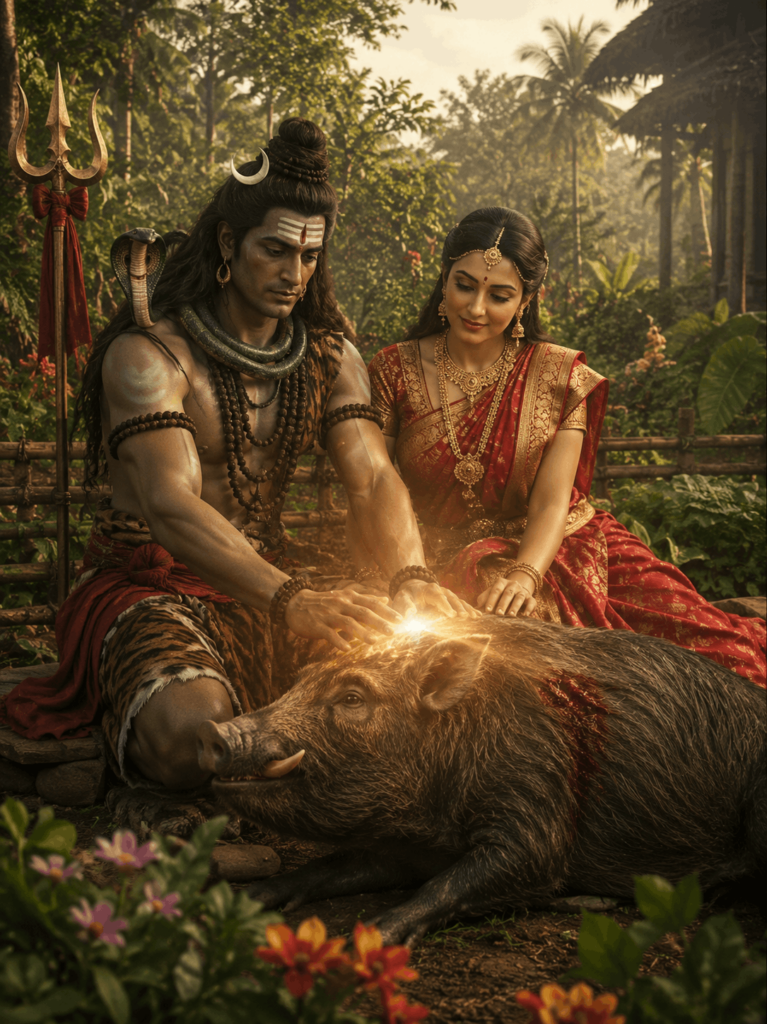
Lord Shiva had a pet wild boar that accidentally destroyed Goddess Parvati’s garden. In a fit of
anger, Shiva killed the boar but immediately regretted it. Parvati, seeing the boar’s innocence,
asked Shiva to bring it back to life. Shiva did so, but sent the boar to Earth to protect the crops
of humans. This spirit became “Panjuruli” (Panji – pig).
He represents Economic Survival. He protects wealth and investments. In the Bunt tradition,
Panjuruli is the one who ensures there is always food on the table and that the prosperity of the
family remains eternal.
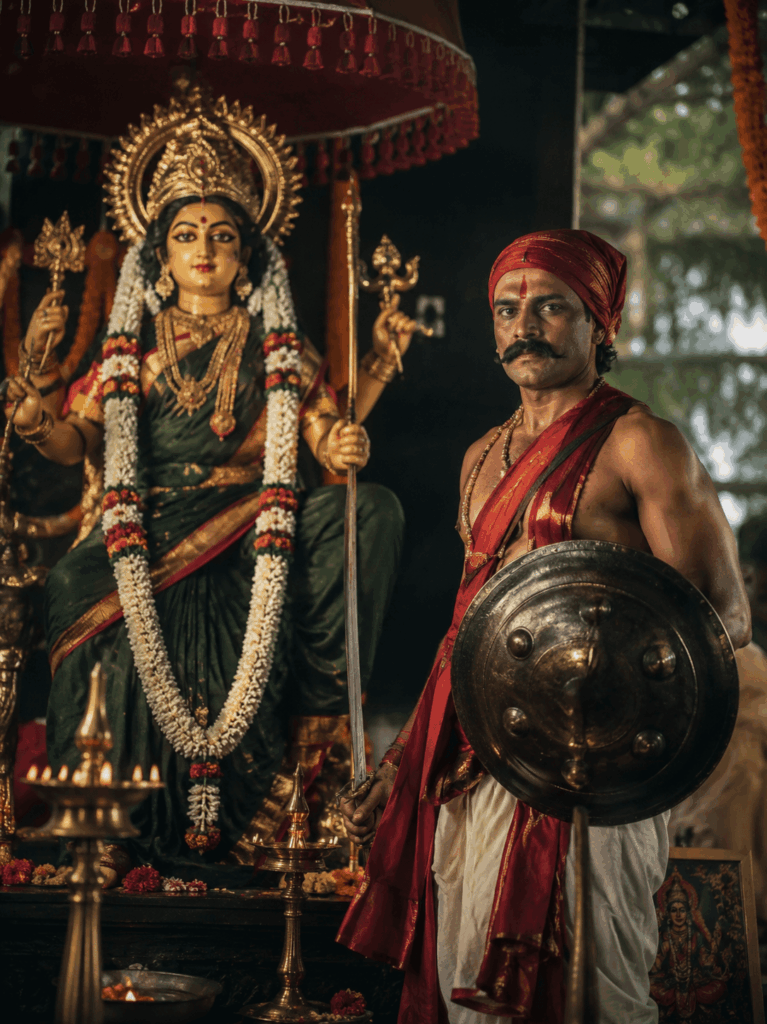
Doomavati is often viewed as a form of the Goddess who traveled from the North. She is a
“Rajandaiva” (Royal Deity). However, she does not act alone; she is always accompanied by
her Banta (the loyal Warrior-Messenger). The Banta is a human hero who served the Goddess
so faithfully that he was elevated to spirit status alongside her.
Banta is the “First Responder.” He is the one who handles the physical safety of the family,
acting on the commands of Doomavati to ward off accidents, illnesses, and physical harm.
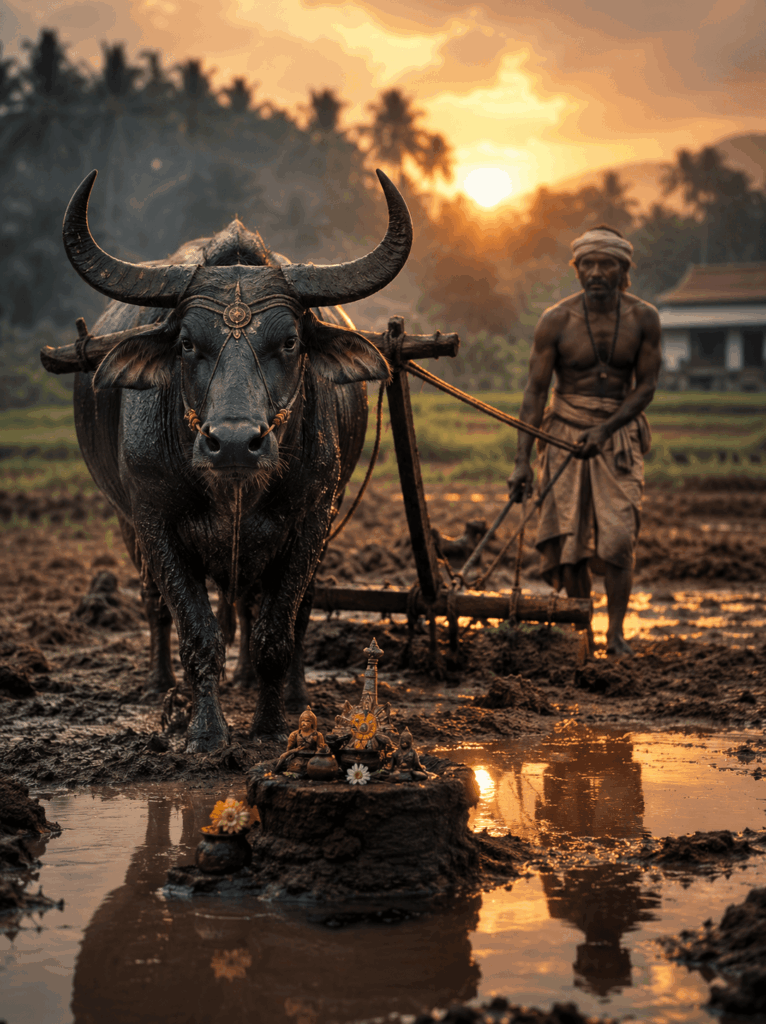
Maisandaya is the spirit associated with the Mahisha (Buffalo). Unlike the Mahisha of the
Puranas who fought Durga, the Tulu Maisandaya is a benevolent guardian of the fields. He is
the spirit of fertility. He is believed to have emerged from the mud of the first plowed field in
Tulunadu.
He is the Guardian of the Bloodline. He ensures that the “root” (Moola) of the family stays
healthy, overseeing the health of pregnant women, the growth of children, and the perpetuity of
the family tree.
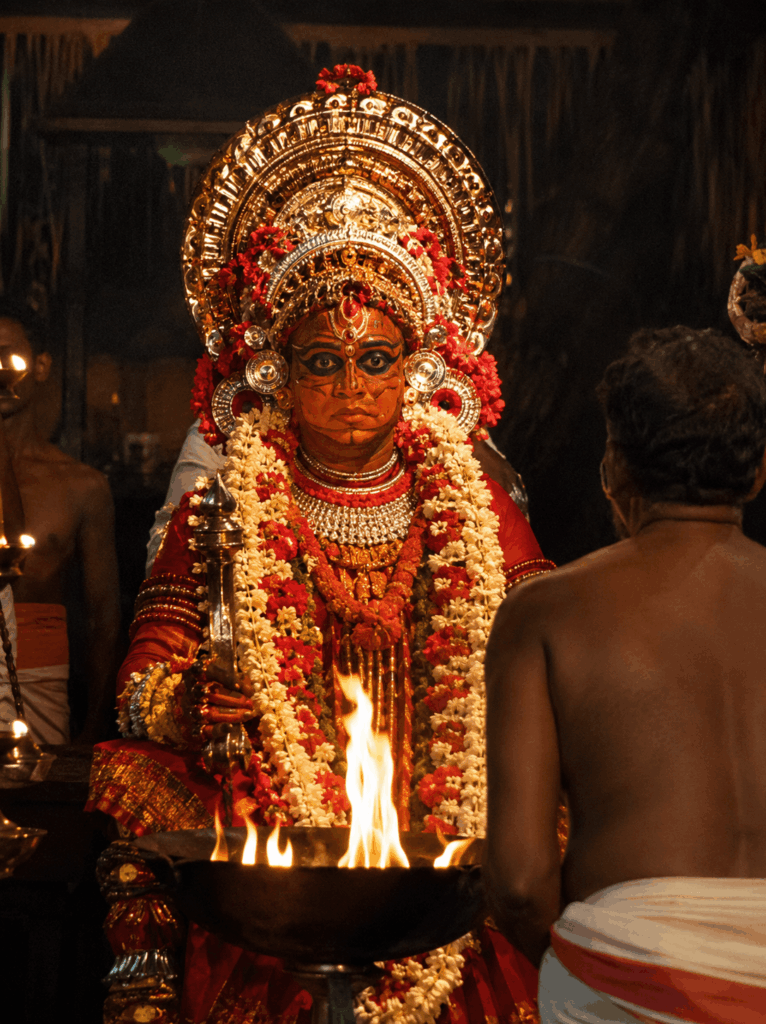
Sathyadevathe is often identified as the sister of the Koti-Chennaya heroes or a companion of
the royal Daivas. Her story is one of “Satyapramana” (The Ordeal of Truth). She is the spirit who
proves that truth is the highest power. In ancient times, if someone was accused of a crime, they
had to swear in front of her. If they lied, they faced her wrath.
She protects the family from deceit and betrayal. She ensures the family stays surrounded by
honest people and protects them from “hidden enemies”.
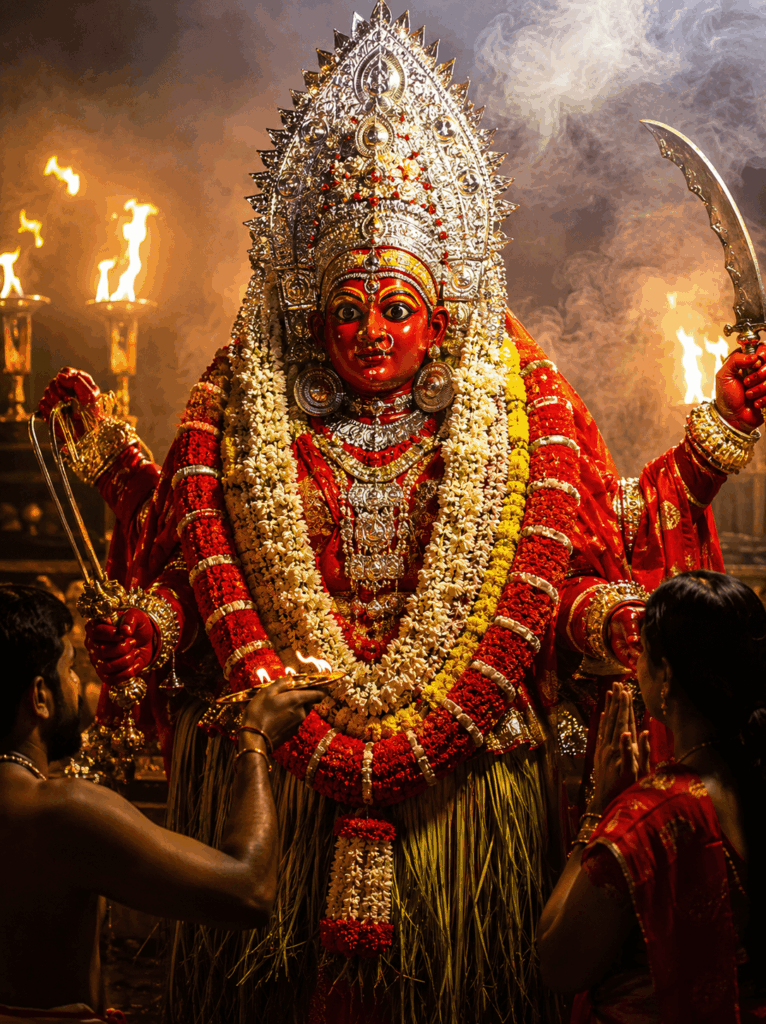
While Puranic Chamundi kills Chanda and Munda, the Tulu Chamundi (often called Kula
Chamundi or Rakteshwari) has a story rooted in the service of the people. She was brought into
Bunt households by the faithful workers (the Moolas and Paryayas) who served the family. She
was their protector first, and through their devotion, she became the protector of the family they
served.
She represents Fierce Loyalty. She protects the family from “black magic” or external spiritual
threats. She is the mother who fights for her children with terrifying strength.
Guliga was born from a stone that was dropped into the sea. When he was born, he was so
hungry that he tried to swallow the Sun. Lord Vishnu had to intervene. Eventually, he was given
the task of being the “Kshetrapala” (Guardian of the Field). He is known for his raw, primal
energy and his “Ugra” (fierce) nature.
Guliga is the External Security. He stands at the boundaries of the property. He is the one who
stops negative spirits, bad luck, and “Kala” (bad time) from entering the house. He is the most
active protector in times of immediate danger.
This family is deeply blessed to be under the divine presence of these daivas,whose energies
together form a spiritual shield of protection and guidance. As long as their lamps continue to be
lit and their sacred stories are remembered and passed through generations,their grace and
presence remain alive and active in our lives.
Adding {{itemName}} to cart
Added {{itemName}} to cart